
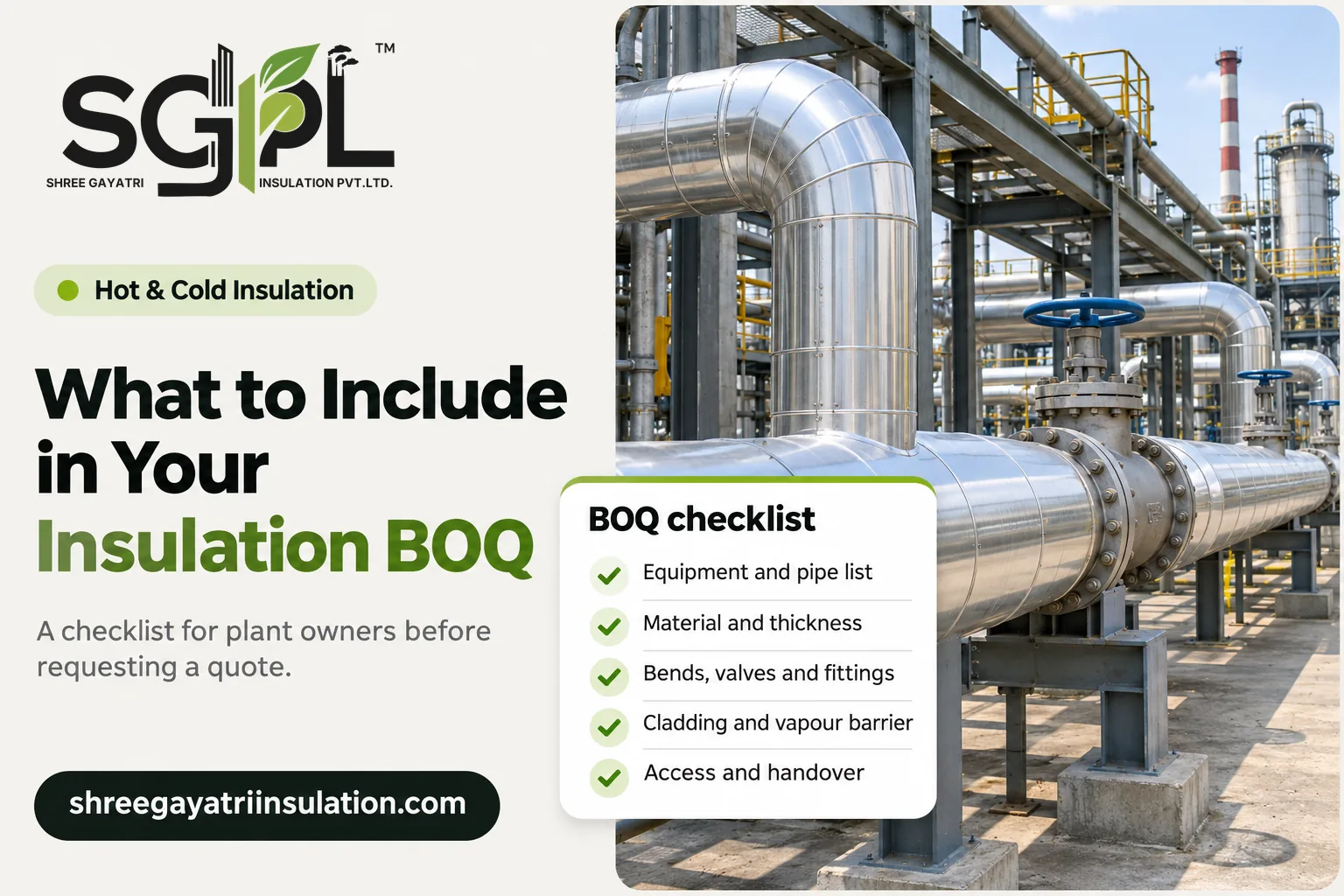
A plant maintenance team identifies 200 metres of steam piping that needs insulation. The procurement department sends the requirement to three contractors and receives three quotations with significantly different prices.
One contractor has included insulation material and labour. Another has added aluminium cladding, bends, and valve insulation. The third has quoted only for straight pipe insulation.
All three quotations may appear to cover the same project, but the actual scope of work is different.
This is a common challenge when preparing an industrial insulation enquiry without a detailed Bill of Quantities (BOQ).
For plant owners looking for a hot and cold insulation contractor in Ahmedabad, a properly prepared BOQ is essential for communicating project requirements, selecting suitable materials, and comparing contractor quotations.
It becomes particularly important when a factory requires insulation for multiple applications, such as steam pipelines, boilers, chilled-water systems, storage tanks, and process equipment.
The following guide explains what to include in an industrial insulation BOQ before requesting a quotation, along with the technical and commercial details that contractors need to understand your project.
What Is an Industrial Insulation BOQ, and Why Does It Matter?
A Bill of Quantities is a document that describes the work required for a project, along with the relevant materials, specifications, quantities, and measurement units.
For industrial insulation, the BOQ should identify which equipment or pipeline sections require insulation, the proposed insulation system, and the extent of installation work.
Consider a manufacturing facility preparing a quotation request for its steam distribution network.
If the BOQ only mentions “steam pipeline insulation – 200 metres”, the contractor still needs to know the pipe sizes, operating temperatures, insulation thickness, material specifications, and cladding requirements.
The contractor must also determine whether bends, valves, flanges and pipe supports are included in the stated quantity.
Without this information, different contractors may prepare their quotations using different assumptions.
A detailed BOQ helps establish a common basis for pricing. It also makes it easier for the plant owner to identify exclusions, compare material specifications, and manage variations during project execution.
For projects involving both hot and cold insulation, the BOQ should distinguish between the two systems because their thermal performance and installation requirements differ.
1. Identify the Equipment and Pipelines That Require Insulation
Before preparing the BOQ, identify the complete insulation scope.
Industrial facilities may require insulation on steam distribution systems, hot-water pipelines, boilers, heat exchangers, reactors, storage tanks, chilled-water lines, and other process equipment.
These applications should not be combined into a single BOQ item unless they share the same approved specification and measurement basis.
For example, a factory in Vatva GIDC may need hot insulation on its steam pipelines and cold insulation on the chilled-water network serving production equipment.
Both requirements involve thermal insulation, but the operating temperatures, selected materials, and finishing details may differ.
A useful starting point is to prepare an equipment-wise or area-wise insulation schedule.
Record the equipment identification number, location, pipe diameter or equipment dimensions, operating conditions, and required insulation type.
Where drawings are available, attach the relevant piping isometrics, equipment drawings, or marked-up layouts.
For existing plants, a site survey can help identify inaccessible pipe sections, damaged insulation, fittings, and other components that may not appear clearly in the available drawings.
BOQ requirement: Define the equipment, piping sections, and surfaces included in the insulation work. Identify any areas that are intentionally excluded.
2. Prepare Separate BOQ Specifications for Hot and Cold Insulation
Hot and cold insulation serve different operating requirements.
For hot systems, insulation is primarily used to reduce unwanted heat loss and support process temperature control. For cold systems, insulation limits heat gain and may also need to control surface condensation and moisture ingress.
Combining both systems under one general insulation specification can create problems during material selection and quotation preparation.
Hot Insulation BOQ: Steam Pipelines, Boilers and Process Equipment
Hot insulation is commonly required on steam pipelines, boilers, heat exchangers, vessels and other equipment operating above ambient temperature.
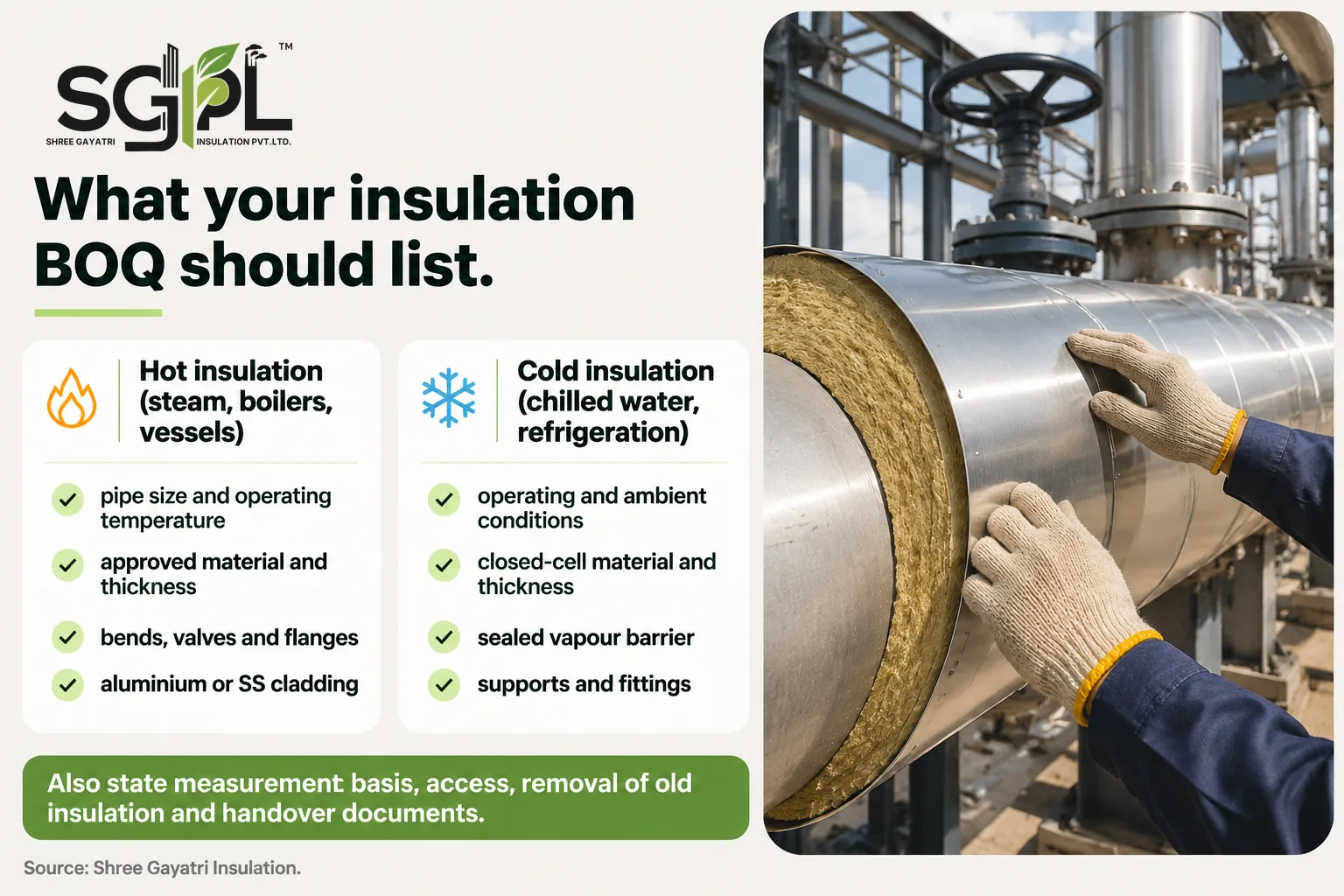
For steam pipe insulation, the BOQ should identify the pipe diameter, operating temperature, required insulation thickness, material specification, and protective finishing.
Consider a manufacturing plant with steam pipelines operating at different temperatures.
The insulation requirements for a high-temperature steam line may differ from those of a lower-temperature condensate return line.
Both should be identified separately if they require different insulation specifications.
The same principle applies to boilers, reactors and other industrial equipment.
Plant owners should also identify whether personnel protection, process temperature control, or another performance objective influences the required insulation system.
Where available, include the approved insulation specification prepared by the plant’s engineering team or project consultant.
Cold Insulation BOQ: Chilled-Water and Refrigeration Systems
Cold insulation is used on equipment and pipelines operating below ambient temperature.
Applications include chilled-water networks, refrigeration lines, cold storage systems and selected industrial process equipment.
For chilled water pipe insulation, the BOQ should identify the operating temperature, ambient conditions, insulation material, thickness and required moisture protection.
Condensation control is an important consideration for cold piping.
When warm, humid air comes into contact with a sufficiently cold surface, moisture can condense. A properly specified insulation system should address both the external surface temperature and the risk of water vapour entering the insulation assembly.
The BOQ should therefore describe the complete cold insulation system rather than listing only the insulation material.
Plant owner tip: Maintain separate hot and cold insulation BOQ sections, even when both types of work are being quoted by the same contractor.
3. Specify the Hot and Cold Insulation Materials
Material selection has a direct influence on the performance and cost of an industrial insulation system.
However, a BOQ mentioning only “thermal insulation material” does not provide enough information for contractors to prepare comparable quotations.
Different materials have different thermal properties, operating temperature limits, physical characteristics, and installation requirements.
The selected product must be appropriate for the intended application and the project’s approved technical specifications.
Hot Insulation Material Selection
Depending on the operating temperature and project requirements, materials such as Rockwool, fiberglass wool and selected ceramic fibre products may be considered for industrial hot insulation.
These materials are available in different forms, including mattresses, slabs, blankets and pipe sections.
For example, Rockwool pipe sections may be considered for suitable piping applications, while mattresses or blankets may be used for selected equipment geometries.
The BOQ should identify the required product form and technical characteristics rather than allowing contractors to substitute materials based only on price.
For each hot insulation item, specify the approved material, required thickness, and relevant product properties.
Cold Insulation Material Selection
Different types of cold insulation material are used for chilled-water systems, refrigeration applications and industrial equipment operating below ambient temperature.
Depending on the application and approved specifications, options may include PUF, PIR, nitrile rubber, XLPE and other suitable insulation products.
These materials are not automatically interchangeable.
The correct selection depends on operating temperature, thermal conductivity, water-vapour permeability, mechanical requirements and the installation environment.
For example, a cold pipeline inside an HVAC plant room may require a different finishing arrangement from an exposed industrial refrigeration pipeline.
The BOQ should identify the proposed insulation material, product form and required protective system.
Shree Gayatri Insulation Pvt. Ltd. supplies insulation products including Rockwool, fiberglass wool, ceramic fibre, PUF, nitrile rubber and XLPE, along with cladding and installation accessories.
BOQ requirement: Specify the approved insulation material and its technical properties. Where alternatives are permitted, require contractors to submit product datasheets for technical review before approval.
4. Define the Required Insulation Thickness
Insulation thickness should not be left to individual contractors to determine independently during quotation.
Two contractors may propose the same insulation material but different thicknesses, resulting in different material quantities, installation costs and thermal performance.
For hot insulation, thickness selection may be influenced by operating temperature, heat-loss requirements, process conditions and the desired external surface temperature.
For cold insulation, thickness selection may also need to account for condensation control under the expected ambient temperature and humidity conditions.
A single plant can contain pipelines of different sizes and operating temperatures, so applying one insulation thickness throughout the facility may not be appropriate.
Where the engineering team has already approved the insulation thickness, include it in the BOQ.
If multiple insulation layers are required, identify the number of layers and the thickness of each layer.
Where thickness calculations are still pending, clearly identify the specification as provisional and request technical review before finalising the quotation.
What to include: Pipe or equipment size, insulation material, approved thickness, number of layers where applicable, and the relevant design or performance requirements.
5. Include Bends, Valves and Fittings in the Industrial Pipe Insulation BOQ
Straight pipe sections are only part of an industrial piping system.
Elbows, tees, reducers, valves, flanges, strainers and pipe supports can require additional insulation material and installation work.
These components may also need different fabrication or finishing arrangements.
For an industrial pipe insulation project, the BOQ should clarify whether fittings are included in the straight pipe insulation rate or measured separately.
Consider a steam pipeline with several valves and flanged connections.
If the quotation includes only the straight pipe length, the contractor may treat insulation of these additional components as extra work.
The problem becomes more significant when different contractors include different fittings in their quotations.
For cold piping, the insulation arrangement around fittings and supports also needs attention because discontinuities can create paths for unwanted heat gain or moisture ingress.
The selected insulation system should address the relevant fittings, joints and supports in accordance with the project specifications.
Include Maintenance Access Requirements
Some equipment components need to remain accessible for inspection and maintenance.
If removable insulation covers are required for valves, flanges or other components, identify them separately in the BOQ.
The specification should indicate the required insulation performance and the arrangement for removing and reinstalling the covers.
This is particularly relevant for operating plants where maintenance teams may need regular access to selected pipeline components.
BOQ requirement: Include the type, size, and quantity of bends, valves, flanges, and other fittings, together with the approved insulation and finishing requirements.
6. Specify Cladding and Vapour Barrier Requirements
The insulation material alone does not necessarily represent the complete insulation system.
Depending on the operating conditions and installation environment, additional protection may be required.
Protective Cladding for Hot Insulation
External cladding is used in many industrial insulation systems to protect the underlying material from mechanical damage and environmental exposure.
Aluminium, galvanised iron and stainless steel are among the materials that may be specified for different industrial applications.
The appropriate cladding depends on the project requirements, surrounding environment and the level of protection needed.
For outdoor pipelines, the BOQ should address cladding joints, overlaps, fastening arrangements and weather protection.
The specification should identify the cladding material and thickness, rather than mentioning only “metal cladding”.
Where bends, valves and other irregular components require fabricated covers, the associated work should also be included.
Vapour Barrier for Cold Insulation
A cold insulation system may require an appropriate vapour barrier to limit moisture entering the insulation.
The installation should address joint sealing, penetrations, fittings and other areas where the vapour barrier could become discontinuous.
Where metal cladding is installed over a vapour barrier, the fastening arrangement should avoid compromising the underlying moisture protection.
For cold insulation projects, the BOQ should identify the approved vapour barrier system, relevant accessories and installation requirements.
BOQ requirement: Clearly state whether cladding, vapour protection, sealants, adhesives and fastening accessories are included in the main insulation rate or measured separately.
7. Include Existing Insulation Removal and Surface Preparation
Insulation work at an operating factory may involve replacing an existing system rather than insulating new equipment.
In such cases, the contractor may need to remove the existing cladding and insulation before installing the replacement material.
The underlying equipment or pipeline may also require inspection and surface preparation.
These activities can influence the final project scope and cost.
For example, removing old insulation from a steam pipeline may reveal areas that require maintenance or protective coating before new insulation can be installed.
The insulation contractor’s responsibilities should be distinguished from those of the plant’s mechanical maintenance team.
Repairs to damaged pipelines, equipment or supports should not be assumed to fall within the insulation scope unless specifically included.
The BOQ should identify responsibility for dismantling, removal, handling and disposal of existing material.
It should also specify whether surface cleaning, painting or protective coating is included in the work.
For an existing plant where the condition of the insulation is uncertain, a site survey can help establish the required scope before final pricing.
8. Define the Installation Conditions and Safety Requirements
Installation conditions can affect the labour, equipment and time required to complete an industrial insulation project.
A pipeline at ground level may be relatively straightforward to access, while insulation work on an elevated pipe rack can require additional access arrangements.
Similarly, work inside an operating manufacturing plant may need to be coordinated with production schedules, maintenance activities, and site safety requirements.
Before approaching industrial insulation contractors in Ahmedabad, provide information about the actual installation conditions.
For factories located in industrial areas such as Vatva GIDC, Naroda, Odhav, Changodar and Sanand, site access requirements should be established according to the specific project location and plant layout.
The BOQ should clarify responsibility for scaffolding, lifting equipment, material handling, and other access arrangements.
If the project requires a plant shutdown, mention the available shutdown window and any restrictions on working hours.
Where special work permits or plant-specific safety procedures apply, these should be communicated during the quotation stage.
This information helps contractors understand the required installation resources and prepare a more accurate execution schedule.
9. Establish a Clear Quantity Measurement and Pricing Basis
Different contractors may use different measurement approaches unless the BOQ defines the required method.
Straight pipeline insulation may be measured by running length or insulated surface area, depending on the agreed specification and contract.
Tanks, vessels and other equipment may require surface-area measurements, while certain fittings or removable covers may be measured individually.
The BOQ should state how the quantities have been calculated and which measurement rules will apply for payment.
For example, the surface area calculated using the bare pipe diameter differs from the external surface area after insulation is installed.
If the contractor and plant owner use different measurement bases, their calculated quantities may not match.
Specify the agreed measurement method before issuing the BOQ for quotation.
For each item, identify the quantity, unit of measurement, and any additional measurement rules.
If the main insulation rate already includes fittings, cladding, or installation accessories, those components should not be charged again under separate BOQ items.
How to Compare Quotations From Pipe Insulation Contractors?
When comparing quotations from different pipe insulation contractors, review the scope and specifications alongside the quoted rates.
One quotation may include insulation material, labour and protective cladding. Another may exclude scaffolding, fittings, transportation or removal of existing insulation.
These differences should be identified before the final commercial comparison.
Ask contractors to provide an itemised quotation with clear exclusions and a defined basis for additional work.
Where the actual installation quantity may change, agree on how variations will be measured and priced.
A consistent BOQ helps the procurement team compare quotations based on the same project requirements.
10. Specify Inspection, Quality Checks and Project Handover
The BOQ should also define the requirements for inspection and acceptance of completed insulation work.
For hot insulation, checks may include material conformity, installed thickness, insulation continuity and the condition of the protective cladding.
For cold insulation, additional attention may be required for joint sealing, vapour barrier continuity and the treatment of supports and fittings.
Inspection requirements should be based on the approved engineering specification and the agreed scope.
Where the project requires performance testing or special inspection procedures, the method and acceptance criteria should be established before work begins.
The BOQ should also specify any required handover documentation.
Depending on the project, this may include approved material datasheets, inspection records, final quantity measurements, and other relevant documents.
Clearly defined acceptance requirements help both the plant owner and contractor understand what constitutes completed work.
Sample BOQ Format for Hot and Cold Insulation Projects
A practical insulation BOQ should make it easy for contractors to identify the work required and prepare an itemised quotation.
The following example can be adapted for industrial pipelines, boilers, vessels and other equipment.
| Item | Description of Work | Unit | Quantity |
| 1 | Supply and installation of approved hot insulation material on steam pipelines, including specified pipe size, insulation thickness and application requirements | Running metre / m² | As per drawings |
| 2 | Supply and installation of approved cold insulation material on chilled-water pipelines, including specified pipe size, insulation thickness and application requirements | Running metre / m² | As per drawings |
| 3 | Insulation of pipe bends, valves, flanges, tees and other specified fittings | Nos. / m² | As per fitting schedule |
| 4 | Supply and installation of approved protective cladding, including specified material, thickness and fastening accessories | m² | As per drawings |
| 5 | Supply and application of the specified vapour barrier system for cold insulation | m² | As per approved specification |
| 6 | Removal and disposal of existing insulation and cladding, where applicable | Running metre / m² | As per site survey |
| 7 | Surface preparation and approved protective coating, where included in the insulation contract | m² | As per scope |
| 8 | Scaffolding, lifting equipment and other specified access arrangements | Item / As agreed | As required |
Important: This is an illustrative BOQ format. The final document should include actual project quantities, approved material specifications, insulation thicknesses, and agreed measurement rules. Items already included in a complete insulation rate should not be priced separately.
Have Your Industrial Insulation BOQ Ready?
Share your BOQ, drawings, or equipment details with Shree Gayatri Insulation Pvt. Ltd. to discuss your hot and cold insulation requirements.
Submit Your BOQ & Request a Quote
What Should You Share With a Hot and Cold Insulation Contractor Before Requesting a Quote?
A complete BOQ is useful, but you do not necessarily need to have every engineering detail finalised before making your initial enquiry.
For an existing plant, the available drawings, photographs and a description of the required work can provide a starting point.
For a new installation, the project consultant or engineering team may already have prepared the equipment drawings and insulation specifications.
Before approaching a contractor, gather the available project information.
| Project Information | Details to Share |
| Project location | Factory address and industrial area |
| Insulation requirement | Hot insulation, cold insulation or both |
| Application | Steam pipeline, chilled-water line, boiler, tank, vessel or other equipment |
| Operating conditions | Normal and design operating temperatures |
| Equipment dimensions | Pipeline diameters and lengths, equipment dimensions or insulation surface area |
| Material specification | Approved insulation material and required technical properties |
| Insulation thickness | Approved thickness or details requiring engineering review |
| Protective finishing | Cladding, vapour barrier and other relevant requirements |
| Existing insulation | New installation, repair or replacement |
| Site conditions | Access arrangements, working restrictions and shutdown requirements |
| Project schedule | Expected commencement and completion requirements |
If the exact material, thickness or quantities are not available, identify these as items requiring further technical review.
A site visit may be necessary where drawings are incomplete or existing equipment conditions need to be assessed.
Providing the available information early helps the contractor identify missing details and prepare a quotation based on the actual project requirements.
Looking for a Hot and Cold Insulation Contractor in Ahmedabad?
Shree Gayatri Insulation Pvt. Ltd. provides hot and cold insulation services and supplies thermal insulation materials for industrial and commercial applications.
Our hot insulation services cover applications such as steam pipelines, boilers, heat exchangers, reactors, and vessels.
For cold insulation requirements, we offer insulation solutions for industrial applications using suitable materials selected according to the operating conditions and project specifications.
Along with insulation materials, we supply supporting products such as aluminium cladding, adhesive tapes, adhesives, coatings, and other insulation accessories.
Our head office is located in Vatva GIDC, Ahmedabad, with an additional branch office in Morbi, Gujarat.
Planning an Industrial Insulation Project?
If you are preparing a BOQ for steam pipe insulation, chilled-water piping, industrial equipment, or insulation replacement, contact Shree Gayatri Insulation Pvt. Ltd. with your project details.
Share your available BOQ, drawings, equipment specifications, and project location.
Our team can discuss your insulation material and installation requirements and identify any additional information needed to prepare a project-specific quotation.
Request a Hot & Cold Insulation Quote
Conclusion
A clear BOQ helps plant owners communicate the complete insulation requirement before requesting contractor quotations.
For hot and cold insulation projects, the document should identify the equipment, operating conditions, approved materials, insulation thickness, fittings, protective finishing, and installation scope.
It should also establish how quantities will be measured and which activities are included in the contractor’s quoted rates.
These details allow procurement teams to compare quotations more consistently and reduce uncertainty during project execution.
If you are planning industrial insulation work in Ahmedabad, share your available BOQ and project specifications with Shree Gayatri Insulation Pvt. Ltd. to discuss your requirements.
Submit Your BOQ & Get an Insulation Quote
Frequently Asked Questions
What should be included in an industrial insulation BOQ?
An industrial insulation BOQ should identify the equipment or pipeline requiring insulation, operating temperature, approved insulation material, thickness, quantities, and installation scope. It should also address fittings, cladding, vapour protection, surface preparation, and access requirements where applicable.
How do I choose a hot and cold insulation contractor in Ahmedabad?
Start by defining your project requirements and preparing a clear BOQ. Ask contractors about their experience with similar industrial applications, proposed insulation materials, installation scope, and quotation exclusions. Compare their quotations using the same approved specifications and quantity measurement basis.
Which materials are used for steam pipe insulation?
Rockwool, fiberglass wool, and other suitable insulation materials may be used for steam piping, depending on the operating temperature and project specifications. Material selection should consider thermal performance, required thickness, installation conditions, and protective finishing.
Which cold insulation material is suitable for chilled-water pipelines?
Materials such as nitrile rubber, XLPE, PUF, and other suitable insulation products may be considered for chilled-water piping. The selected material and thickness should meet the project’s thermal and condensation-control requirements. Moisture protection and the treatment of joints and supports are also important considerations.
What information do pipe insulation contractors need to prepare a quotation?
Contractors generally need the pipeline dimensions, operating temperature, total quantity, insulation specifications, and details of bends, valves, and other fittings. The enquiry should also identify cladding requirements, site conditions, and any existing insulation that needs to be removed.
How much does industrial pipe insulation cost in Ahmedabad?
Industrial pipe insulation cost depends on the pipe size, insulation material, required thickness, total quantity, protective cladding and installation conditions. Additional work involving fittings, elevated pipelines, or removal of existing insulation may affect the project cost. An itemised quotation based on the actual BOQ is required to establish the price.
Can hot and cold insulation work be included in the same BOQ?
Yes. A single BOQ can cover both hot and cold insulation work. However, each system should have separate items and specifications so contractors can identify the applicable materials, thicknesses, protective finishing, and quantities.
Does Shree Gayatri Insulation provide industrial insulation services in Ahmedabad?
Yes. Shree Gayatri Insulation Pvt. Ltd. provides hot and cold insulation services and supplies insulation materials for industrial and commercial applications. Plant owners, maintenance teams, and contractors can contact the Ahmedabad office to discuss their requirements and request a project-specific quotation.