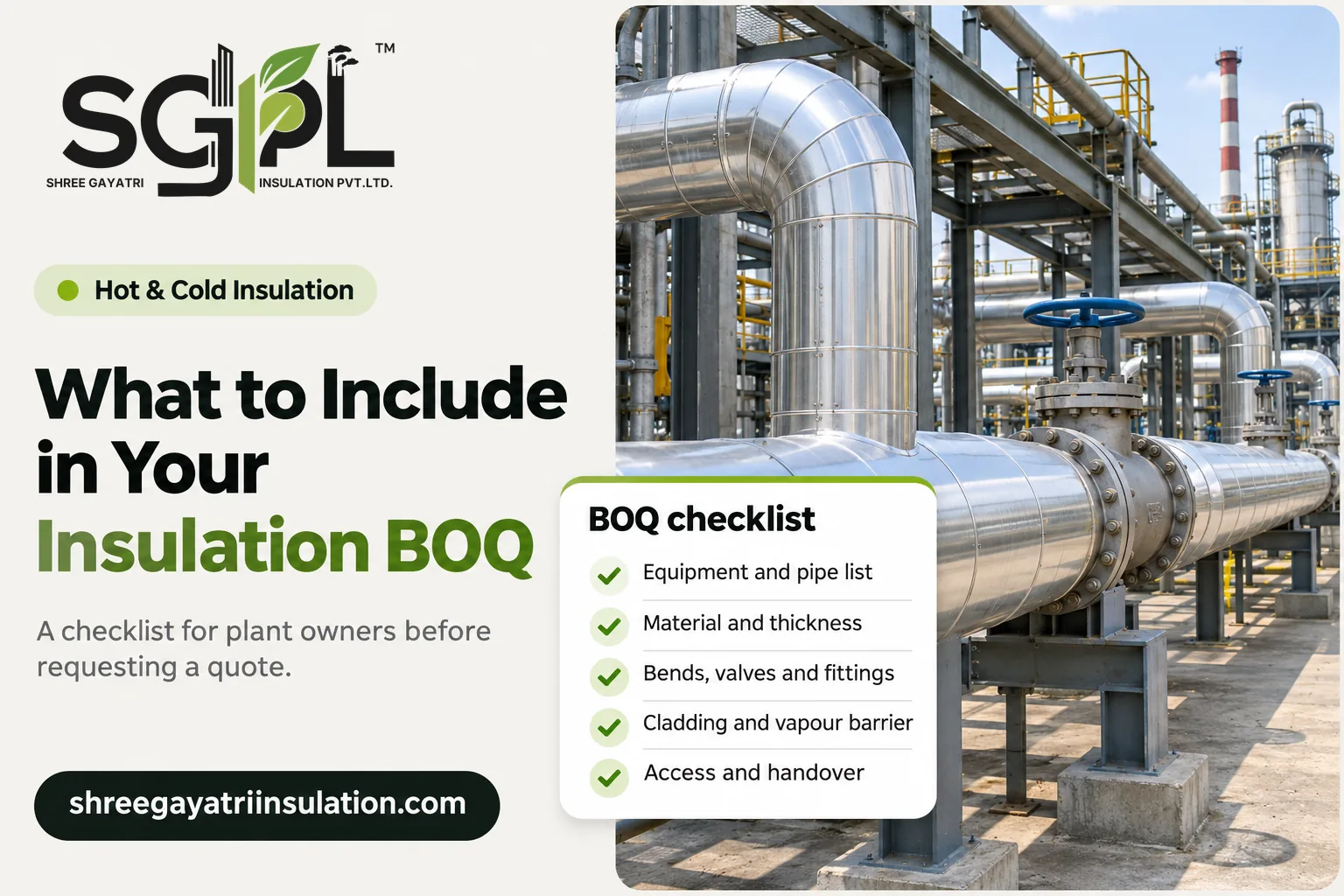


A low insulation quotation can look attractive until installation begins and you discover that cladding, fittings, access equipment, or important sections of the pipeline were never included in the price.
For industrial projects, comparing quotations involves more than checking the total amount. The insulation material, operating temperature, application method, and installation scope all influence how the finished system performs.
A steam pipeline in a chemical plant does not have the same insulation requirements as a chilled-water line in an HVAC system. Similarly, insulating a boiler, storage tank, or industrial shed requires a different approach.
When evaluating industrial insulation contractors in Gujarat, it is important to establish what your project needs before asking different companies to submit their prices.
The following 12 checks will help you prepare a clearer enquiry, compare quotations on the same basis, and understand what to discuss with a contractor before placing an order.
1. Check Whether the Contractor Has Experience With Your Type of Industrial Insulation
Industrial insulation covers a wide range of applications. A contractor experienced in roof insulation may not necessarily have the same installation experience with high-temperature equipment or chilled-water pipelines.
Start by identifying the main application involved in your project.
For example, a manufacturing facility may require insulation for steam pipelines, boilers, heat exchangers, or process vessels. A commercial or industrial HVAC project may involve chilled-water pipelines, air ducts, and refrigeration equipment.
Ask the contractor about previous work involving similar equipment and operating conditions.
For a large or technically demanding project, request relevant project photographs, references, or examples of completed installations.
It is also useful to understand whether the company will execute the insulation work directly or engage a separate installation team.
What to ask: Have you previously completed insulation work for equipment or pipelines operating under conditions similar to ours?
2. Confirm the Operating Temperature and Application Requirements
Before selecting an insulation material, the contractor should understand what the system does and the conditions under which it operates.
A request stating only “pipeline insulation required” does not provide enough information to select an appropriate insulation system.
For an industrial pipeline, the operating temperature, pipe diameter, total length, and surrounding environment are all relevant.
For boilers, vessels, and other process equipment, additional details such as equipment dimensions, surface temperature, and maintenance access may be required.
The project location also matters.
An outdoor installation in an industrial area such as Dahej or Ankleshwar may face different exposure conditions from equipment installed inside a factory in Ahmedabad.
Provide the following information wherever available:
- Equipment or pipeline type and dimensions.
- Normal and design operating temperatures.
- Indoor or outdoor installation conditions.
- Required insulation performance or existing project specifications.
- Available drawings, equipment layouts, and site photographs.
If these details are not yet available, discuss what information is required before finalising the material selection and quotation.
3. Identify Whether Your Project Requires Hot Insulation, Cold Insulation or Both
Hot insulation and cold insulation serve different operating requirements. Although both are intended to control heat transfer, their material selection and installation details can differ significantly.
Hot insulation
Hot insulation is used on equipment and pipelines operating above ambient temperature.
Applications include steam pipelines, boilers, heat exchangers, reactors, and other industrial process equipment.
The insulation system is selected to control heat loss, support process temperature requirements, and address personnel protection where applicable.
The material must be suitable for the operating temperature and the relevant installation conditions.
For industrial facilities considering hot insulation services, the quotation should clearly identify the proposed insulation material, thickness and external protection.
Cold insulation
Cold insulation is used where equipment or piping operates below the surrounding ambient temperature.
Common applications include chilled-water pipelines, refrigeration equipment, cold storage systems and selected industrial process lines.
In addition to limiting heat gain, the insulation system may need to control surface condensation and moisture ingress.
The selection of appropriate insulation material, joint sealing and vapour protection is particularly important for cold applications.
For a facility requiring both hot and cold insulation, request separate specifications for each system rather than using a single material specification for all equipment.
4. Ask Which Insulation Material Is Being Recommended and Why
Different insulation materials have different thermal, mechanical, and moisture-related characteristics.
Material selection should be based on the equipment’s operating conditions and the performance expected from the complete insulation system.
For example, Rockwool and fiberglass wool are used in a range of thermal insulation applications. Ceramic fibre products may be considered for selected high-temperature applications.
Materials such as PUF, PIR, nitrile rubber and XLPE are used in various cold insulation and HVAC applications, depending on their individual specifications.
Shree Gayatri Insulation Pvt. Ltd. supplies a range of these materials along with cladding, adhesives, tapes, and other insulation accessories.
However, selecting a familiar material name is not enough.
Two products within the same material category can differ in density, thermal conductivity, operating temperature limits, physical form, and other properties.
Ask the contractor to identify the proposed product and provide the relevant technical datasheet.
The material should be evaluated against the project’s operating temperature, moisture conditions, installation requirements, and applicable specifications.
What to ask: Which insulation material are you recommending for our application, and what technical information supports that recommendation?
5. Confirm the Proposed Insulation Thickness
Insulation thickness has a direct influence on the thermal performance of an insulation system.
A quotation mentioning the material but not its thickness leaves an important part of the specification undefined.
The required thickness depends on factors such as operating temperature, ambient conditions, thermal conductivity, surface dimensions, and the intended insulation objective.
For hot equipment, thickness may be selected to meet a heat-loss limit, surface-temperature requirement, or another project-specific performance objective.
For cold pipelines, thickness selection may also need to account for condensation control under the expected ambient temperature and humidity conditions.
The correct thickness should therefore be determined from the relevant design requirements rather than selected solely because a particular thickness is commonly available.
For a project with multiple pipeline sizes and operating temperatures, different insulation thicknesses may be required.
Before requesting a final quotation, ask the contractor to identify the proposed thickness for each application and explain the basis for selection.
6. Check Exactly What Is Included in the Insulation Work
One of the most useful documents to prepare before requesting an industrial insulation quotation is a clear scope of work.
Consider a factory that requires insulation for a steam pipeline running from a boiler to a production area.
The main pipeline may account for most of the work, but it may also contain bends, valves, flanges, strainers, supports and other components that need individual treatment.
If the enquiry covers only the straight pipeline length, the quotation may not include all the work required for a complete installation.
The same issue can arise when insulating storage tanks, vessels and industrial equipment with multiple connections or access points.
Ask the contractor to confirm which surfaces and components are included.
A useful scope should identify the equipment or pipeline sections to be insulated, the dimensions or quantities involved, and any areas intentionally excluded.
For existing facilities, confirm whether the project also involves removing old insulation, preparing surfaces, or replacing damaged cladding.
These activities can materially affect the total project cost and execution schedule.
7. Review the Cladding, Weather Protection and Vapour Barrier Requirements
Insulation material is only one part of a complete industrial insulation system.
Depending on the application, protective cladding, weather sealing, vapour barriers and supporting accessories may also be required.
For outdoor industrial equipment, external cladding can help protect insulation from mechanical damage and environmental exposure.
However, the cladding material, thickness, fastening method and joint details should be selected according to the installation conditions.
For below-ambient applications, vapour protection is an additional consideration.
A damaged or discontinuous vapour barrier can allow moisture to enter the insulation system, potentially reducing its performance and contributing to corrosion-related problems.
The National Insulation Association’s mechanical insulation guidance identifies moisture protection, vapour retarders and the integrity of the insulation system as important design and installation considerations.
Before approving a quotation, confirm whether the proposed price includes the required cladding, joint sealing, adhesives, fasteners and vapour protection.
Also clarify whether any surface preparation or protective coating beneath the insulation is included in the contractor’s scope.
8. Understand How the Contractor Will Insulate Bends, Valves and Equipment Supports
Straight pipeline sections are generally easier to measure and insulate than irregular components.
Bends, valves, flanges, nozzles and equipment supports can require additional cutting, fitting, fastening and finishing work.
These areas also need to remain compatible with the facility’s inspection and maintenance requirements.
For example, valves and flanges may need to be accessed during maintenance. Where removable insulation is required, that requirement should be stated before quotation.
Pipe supports and other attachments should also be considered during insulation design.
If the insulation stops abruptly at every support or fitting, the completed system may contain unwanted thermal gaps.
On cold systems, poorly sealed joints and penetrations can also create routes for moisture ingress.
Ask the contractor how these components will be treated and whether the quotation includes the necessary insulation accessories and finishing work.
A quotation that includes only straight pipe insulation should not be compared directly with one covering the complete pipeline assembly.
9. Verify Site Access, Safety Requirements and Installation Conditions
The installation environment can have a considerable influence on industrial insulation work.
Insulating a pipeline at ground level is different from working on an elevated pipe rack or around equipment inside an operating manufacturing plant.
Before requesting a quotation, inform the contractor about the actual site conditions.
Consider whether the work will require scaffolding, lifting equipment, restricted-area access, shutdown coordination, or special work permits.
For an operating plant, also clarify the permitted working hours and whether any equipment must remain in service during the project.
The contractor should understand the site’s safety requirements before committing to an execution schedule.
For example, insulation work near hot equipment, moving machinery, or elevated platforms may require additional safety arrangements and coordination with the plant team.
Confirm whether access equipment, labour safety arrangements, material movement, and related site expenses are included in the quoted amount or will be handled separately.
10. Check Material Availability and the Proposed Project Schedule
An industrial insulation project may depend on the delivery of several different materials.
In addition to the main insulation material, the contractor may require cladding sheets, adhesives, tapes, wire mesh, fasteners, fittings, and other accessories.
A delay in one essential component can affect the installation schedule, even when the main insulation material is available.
Ask the contractor to confirm the expected material delivery period and the proposed installation timeline.
For a large project, understand whether materials will be supplied in phases or delivered together.
Also discuss how the work will be coordinated with mechanical installation, equipment maintenance, or a planned plant shutdown.
If the project has a fixed completion date, make that requirement clear during the enquiry stage.
For factories and industrial facilities in Gujarat, it can also be useful to discuss how materials will reach the project location and whether unloading, storage, and internal transportation are included.
11. Compare the Complete Quotation, Not Just the Price Per Square Metre
Industrial insulation quotations may be prepared using different measurement methods depending on the application and agreed scope.
Some work may be measured by insulated surface area, pipeline length, equipment quantity or another project-specific method.
This makes direct price comparison difficult unless the proposed material specifications and scope of work are the same.
For example, consider two quotations for an industrial pipeline.
Contractor A includes insulation material, installation labour, external cladding, bends and fittings.
Contractor B quotes only for the straight pipeline insulation and excludes cladding, access equipment and additional fittings.
Even if Contractor B offers a lower initial price, the quotations do not represent the same scope.
To make a meaningful comparison, request an itemised quotation.
It should clearly identify:
- Insulation material and proposed thickness.
- Insulated equipment or pipeline quantities.
- Installation labour and required accessories.
- Cladding and protective finishing.
- Access equipment, transportation and site expenses.
- Applicable taxes and payment terms.
- Exclusions and the basis for any additional charges.
Also confirm how variations will be measured and priced if the actual work quantity changes during execution.
The quotation with the lowest initial amount is not necessarily the quotation with the lowest final project cost.
A clear scope and measurement basis will help your procurement team compare contractors more effectively.
12. Confirm Inspection, Quality Checks and Project Handover Requirements
Before placing the order, discuss how the completed insulation work will be inspected and accepted.
The inspection requirements should reflect the application, project specifications and agreed scope.
For example, a pipeline insulation project may require checks for material conformity, insulation thickness, continuity, joint finishing and the condition of external cladding.
Cold insulation projects may require additional attention to vapour barrier continuity and joint sealing.
Outdoor installations should also be checked for visible gaps, damaged cladding and locations where water could enter the insulation assembly.
Where performance testing or special inspection is required, the method and acceptance criteria should be agreed before work begins.
The National Insulation Association’s guidance recommends defining field inspection requirements, installation details and finishing requirements within the insulation specification rather than leaving them open to interpretation.
For industrial projects, clarify which documents will be provided at completion.
Depending on the agreed scope, these may include material datasheets, inspection records, final measurements, and other relevant handover documents.
A documented handover helps the plant’s maintenance team understand the installed insulation system and identify future repair or replacement requirements.
What Information Should You Share With an Industrial Insulation Contractor Before Requesting a Quote?
Once you have reviewed the 12 checks, the next step is to prepare a project enquiry with enough information for the contractor to understand the application.
You do not need to have every technical detail finalised before making the first inquiry. However, sharing the available information can help the contractor identify missing details and determine whether a site visit or further technical discussion is necessary.
For a new industrial project, the equipment drawings and insulation specifications may already be available.
For an existing factory, photographs, approximate measurements, and a description of the insulation problem can provide a useful starting point.
Industrial Insulation Quotation Checklist
| Information Required | Details to Share |
| Project location | City, industrial area and site address |
| Application | Steam pipeline, boiler, tank, vessel, HVAC, roof or other application |
| Insulation type | Hot insulation, cold insulation, acoustic insulation or another requirement |
| Operating temperature | Normal and design temperatures, if available |
| Dimensions | Pipeline diameter and length, equipment dimensions or insulation area |
| Existing insulation | New installation, repair or replacement |
| Site conditions | Indoor/outdoor location, access restrictions and operating plant conditions |
| Material requirements | Approved specifications or preferred materials, if any |
| Project timeline | Expected starting date, shutdown window or required completion period |
Where detailed specifications are unavailable, mention that the proposed material and insulation thickness require technical review.
For larger projects, a site assessment may be needed to establish accurate quantities and installation requirements.
Share Your Project Details & Request a Quote
Industrial Insulation Services in Gujarat by Shree Gayatri Insulation Pvt. Ltd.
Shree Gayatri Insulation Pvt. Ltd. supplies insulation materials and provides industrial insulation services for a range of thermal insulation applications.
Our service portfolio includes hot insulation, cold insulation, acoustic insulation, building insulation, underdeck insulation, overdeck insulation, and PEB insulation.
For industrial applications, our services cover thermal insulation requirements involving equipment such as pipelines, boilers, vessels and heat exchangers, subject to the specific project scope and technical requirements.
We also supply a range of insulation materials and accessories, including Rockwool, fiberglass wool, ceramic fibre, PUF, EPS, XPS, nitrile rubber, XLPE, aluminium cladding and related installation materials.
With our head office in Vatva GIDC, Ahmedabad, and a branch office in Morbi, we support industrial insulation material requirements and project enquiries across Gujarat.
Planning a New Insulation Project or Replacing Existing Insulation?
If you are preparing an insulation requirement for a manufacturing plant, commercial facility, or industrial building, contact our team with your project details.
Share the application, equipment dimensions, operating conditions, preferred insulation specifications, and project location.
Our team can discuss your requirements and the information needed to prepare a quotation for the relevant products or services.
Request an Industrial Insulation Quote
Conclusion
Selecting an industrial insulation contractor involves more than comparing material prices and installation charges.
The operating conditions, proposed insulation material, thickness, installation scope, and protective finishing all influence the completed system.
Before requesting quotations, prepare a clear description of your project and identify the technical and commercial details that need to be confirmed.
When contractors receive the same project information and quotation requirements, your procurement team can compare their proposals more effectively.
For industrial insulation material requirements or project enquiries in Gujarat, contact Shree Gayatri Insulation Pvt. Ltd. with your application details and available specifications.
Get a Quote for Your Industrial Insulation Project
Frequently Asked Questions About Industrial Insulation Contractors in Gujarat
How do I choose an industrial insulation contractor in Gujarat?
Start by identifying your insulation application, operating conditions, and project requirements. Ask contractors about relevant installation experience, material specifications, proposed insulation thickness, and the complete scope of work. Compare itemised quotations rather than evaluating companies on price alone.
What information is required for an industrial insulation quotation?
An initial enquiry should include the application, operating temperature, equipment or pipeline dimensions, project location, and available technical specifications. For an existing facility, photographs and information about the current insulation condition can also be helpful. Additional details may be required before the final quotation is prepared.
How much does industrial insulation cost in Gujarat?
Industrial insulation cost depends on the material, thickness, total quantity, equipment configuration, cladding requirements, installation access, and project scope. Hot insulation and cold insulation projects may require different materials and installation methods. A project-specific quotation is needed to determine the actual cost.
What is the difference between an insulation material supplier and an insulation contractor?
An insulation material supplier provides products such as Rockwool, fiberglass wool, ceramic fibre, PUF, nitrile rubber, and cladding materials. An insulation contractor undertakes the installation work according to the agreed project scope. Some companies offer both material supply and insulation installation services.
Why is vapour barrier protection important in cold insulation?
Cold equipment and pipelines operate below ambient temperature, which can create conditions for surface condensation. An appropriately designed and installed vapour barrier helps limit moisture entering the insulation system. The required vapour protection depends on the insulation material, operating conditions, and installation environment.
Can industrial insulation be installed on existing equipment and pipelines?
Yes. Industrial insulation can be installed on suitable existing equipment and pipelines, subject to their condition and the project requirements. For insulation replacement, the existing system may need to be removed so the underlying surface can be inspected and prepared before new insulation is applied.