
Two factories can request insulation for the same length of pipeline and receive completely different quotations.
One project may require 50 mm Rockwool insulation with aluminium cladding. Another may need a different insulation thickness, multiple layers, additional fittings, or a specialised moisture-protection system.
The pipeline length may be identical, but the material consumption, installation work, and total project cost will not be.
This is why calculating industrial insulation cost in Gujarat involves more than checking the price of Rockwool, PUF, or other thermal insulation materials.
For factory owners and procurement teams planning projects in 2027, the important question is not simply how much insulation costs per square foot. It is what the quoted price includes and whether the proposed system meets the project’s technical requirements.
This guide breaks down the main components of industrial insulation pricing, including material selection, insulation thickness, cladding, labour, installation conditions, and additional project expenses.
It also explains how to calculate the basic quantities for a pipeline insulation project and compare quotations from different contractors.
How Much Does Industrial Insulation Cost in Gujarat?
There is no single rate that applies to every industrial insulation project.
The cost of insulating a steam pipeline differs from that of a chilled-water line, boiler, storage tank, or industrial roofing system.
Even within the same factory, different equipment may require different insulation materials, thicknesses, and protective finishing.
For a reliable estimate, the contractor needs to understand the operating conditions, equipment dimensions, material specifications, and installation scope.
The total installed cost generally consists of the insulation material, protective finishing, installation labour, and any additional work required to complete the project.
Industrial Insulation Cost Breakdown
| Cost Component | What It Includes | Main Pricing Factors |
| Insulation material | Rockwool, fiberglass wool, ceramic fibre, PUF, PIR, nitrile rubber or other approved material | Material type, technical properties, thickness and quantity |
| Protective cladding | Aluminium, GI, stainless steel or another specified covering | Sheet material, thickness, surface area and fabrication |
| Installation labour | Cutting, fitting, fastening, sealing and finishing | Equipment geometry, work quantity and installation complexity |
| Insulation accessories | Fasteners, adhesives, tapes, bands and other required materials | Insulation system and application method |
| Surface preparation | Removal of existing insulation, cleaning and specified coating work | Existing equipment condition and project scope |
| Access and site expenses | Scaffolding, lifting, material handling and transportation | Equipment location, working height and site restrictions |
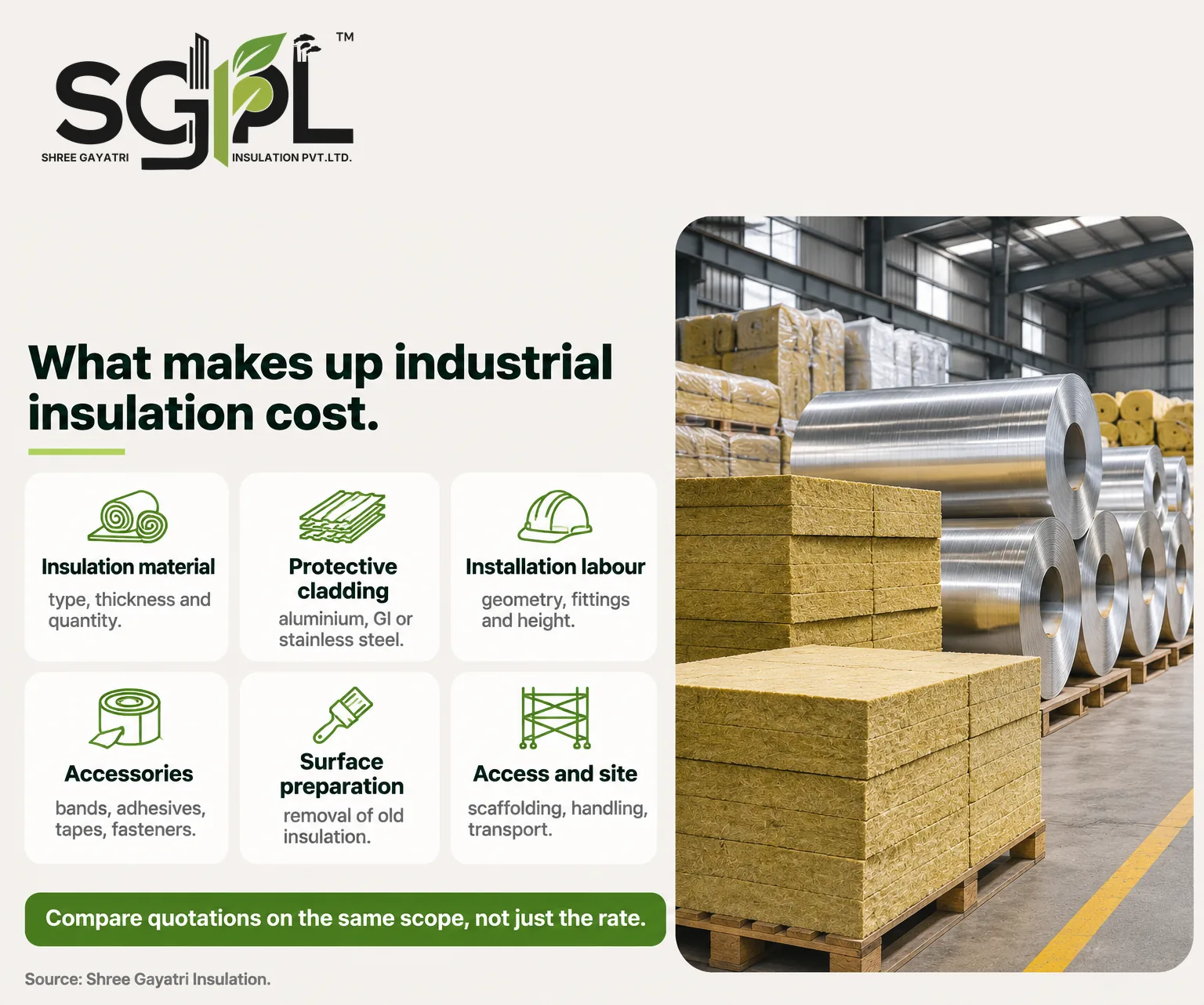
These components should be clearly identified in the project quotation.
A material-only price should not be compared directly with a complete supply-and-installation quotation.
Planning an industrial insulation project?
Share your equipment details, insulation specifications, or BOQ with Shree Gayatri Insulation Pvt. Ltd. to discuss your requirements and request a project-specific quotation.
Request an Industrial Insulation Quote
1. Insulation Material Cost: Rockwool, Fiberglass Wool, Ceramic Fibre, PUF and Other Materials
Material selection is one of the first decisions that affects the cost of industrial insulation.
Different insulation materials are manufactured for different operating temperatures, mechanical requirements, and environmental conditions.
A material that works for a steam pipeline may not be appropriate for chilled-water piping. Similarly, insulation used on a high-temperature industrial furnace may have different requirements from insulation installed beneath an industrial roof.
Comparing material prices without considering these differences can lead to an unsuitable insulation specification.
Rockwool Insulation Price and Cost Factors
Rockwool is used in a range of industrial thermal insulation applications, including pipelines, boilers, equipment and selected building systems.
It is available in different forms, such as LRB mattresses, slabs and pre-formed pipe sections.
When comparing the Rockwool insulation price, buyers should check the exact product being quoted.
A Rockwool LRB mattress and a Rockwool pipe section are different product forms. Their pricing, material quantities, and installation requirements should be assessed according to the intended application.
The quoted price may also vary with the product’s density, thickness, dimensions, manufacturer, and technical specifications.
For example, a procurement team requesting Rockwool for steam pipe insulation should identify the pipe size, operating temperature, required insulation thickness, and approved product form.
A generic Rockwool price per square metre does not establish the total cost of insulating that pipeline.
Buyer consideration: Compare the price of the approved Rockwool product at the required thickness, not simply the lowest available Rockwool material rate.
Fiberglass Wool Insulation Cost
Fiberglass wool is available in products such as rolls, slabs and other insulation forms.
It may be used in suitable thermal and acoustic insulation applications, including selected industrial equipment, ductwork and building systems.
The material cost depends on the product specification, thickness, density, facing and required quantity.
For example, an aluminium-foil-faced fiberglass wool product may have a different material price from a plain fiberglass wool roll.
The appropriate product should be selected according to the thermal and installation requirements of the project.
If fiberglass wool is being compared with another insulation material, the comparison should consider the complete installed system rather than only the cost of the insulation roll.
Ceramic Fibre Insulation Cost
Ceramic fibre products are used in selected high-temperature industrial insulation applications.
Depending on the equipment and approved design, these may include furnaces, kilns and other high-temperature process systems.
Material selection should be based on the relevant operating temperature, thermal requirements and product specifications.
For procurement teams, the important point is to avoid comparing different high-temperature insulation materials solely on their price per kilogram.
The appropriate product form, installed thickness, density, supporting arrangement and protective system can all influence the final cost.
PUF, PIR, Nitrile Rubber and XLPE Insulation Cost
Cold insulation projects may use materials such as PUF, PIR, nitrile rubber and XLPE, depending on the application and approved specifications.
These materials differ in their physical characteristics, thermal properties and installation requirements.
For example, a chilled-water pipeline insulated with elastomeric rubber may require different material quantities and installation accessories from a pipeline insulated with a rigid PUF system.
In addition to the insulation material, cold insulation cost may include joint sealing, vapour protection, and other components required by the system design.
For cold applications, selecting material based only on the lowest purchase price can overlook important moisture-control requirements.
Shree Gayatri Insulation supplies a range of materials for hot and cold insulation applications, including Rockwool, fiberglass wool, ceramic fibre, EPS, PUF, PIR, XLPE and nitrile rubber.
2. How Insulation Thickness Affects the Total Project Cost
Insulation thickness is one of the most important variables in industrial insulation costing.
For the same equipment dimensions, increasing insulation thickness generally increases material consumption.
On a pipeline, it also increases the finished outside diameter of the insulation system. This can affect the quantity of protective cladding required.
However, the relationship between thickness and project cost is not always proportional.
Increasing the insulation thickness from 50 mm to 100 mm does not necessarily mean that the complete installed cost will double.
The actual change depends on the pipeline diameter, insulation material, number of layers, cladding requirements, and installation method.
Example: 50 mm vs 100 mm Pipe Insulation
Consider a straight industrial pipeline with an outside diameter of 100 mm.
If 50 mm insulation is applied, the finished outside diameter becomes approximately 200 mm, excluding cladding thickness.
If the insulation thickness increases to 100 mm, the finished outside diameter becomes approximately 300 mm.
The thicker system requires a larger quantity of insulation material and a greater external surface area for cladding.
For a long pipeline, these differences can materially affect the project estimate.
The final thickness must nevertheless be determined by the engineering requirements, not by whichever option offers the lower initial price.
Why the Required Thickness Matters?
For hot insulation, the required thickness may depend on operating temperature, heat-loss limits and personnel protection requirements.
For cold insulation, ambient temperature, relative humidity and condensation control can influence the thickness selection.
A properly designed insulation system may also be evaluated for its total lifecycle cost, including the initial installation cost and the value of reduced unwanted heat transfer over its service life.
For procurement teams, this means that reducing insulation thickness solely to lower the quotation can change the expected thermal performance of the finished system.
The better approach is to establish the required insulation performance first and then compare suitable materials and installation options.
3. Aluminium Cladding Cost for Industrial Insulation
Protective cladding is another important component of industrial insulation pricing.
In many applications, the insulation material is covered with a protective sheet to reduce exposure to weather, mechanical damage, and other environmental conditions.
Depending on the project specifications, cladding materials may include aluminium, galvanised iron, or stainless steel.
These materials have different purchase costs, fabrication requirements, and suitability for different environments.
What Affects Aluminium Cladding Sheet Prices?
The price of an aluminium cladding sheet depends on its alloy, thickness, dimensions, surface finish and purchased quantity.
However, the sheet purchase price is not the same as the cost of finished insulation cladding.
A complete cladding quotation may also need to include fabrication, cutting, rolling, bends, fasteners, overlaps and installation labour.
For a straight pipeline, the cladding requirement can be estimated from the finished external circumference and pipeline length.
For boilers, tanks and vessels, the shape of the equipment and the number of openings can make the fabrication work more complex.
The final cladding quantity should account for the relevant project drawings, fitting details and agreed measurement rules.
Aluminium vs GI vs Stainless Steel Cladding
Aluminium cladding is used in a range of industrial insulation applications because it is relatively lightweight and can be fabricated into protective coverings.
GI and stainless steel may also be specified, depending on the equipment location and environmental conditions.
The selected material and thickness should be appropriate for the project rather than substituted to reduce the initial cost.
For example, equipment installed outdoors in a chemically aggressive industrial environment may require different cladding considerations from piping installed inside a dry mechanical room.
Shree Gayatri Insulation supplies aluminium sheets and other industrial cladding materials used in insulation applications.
Procurement tip: When requesting an insulation quotation, ask the contractor to specify the cladding material, thickness, installed quantity, and included fabrication work.
This makes it easier to understand whether two quotations cover the same protective system.
4. Industrial Insulation Labour Charges and Installation Cost
Material prices are relatively straightforward to compare when the specifications and quantities are identical.
Labour charges are more difficult to standardise because the amount of work required depends on the equipment configuration and installation conditions.
Consider two industrial insulation projects involving the same total pipe length.
The first project involves an accessible straight pipeline at ground level.
The second involves a pipeline running through an elevated pipe rack with multiple bends, valves, flanges, and support structures.
Even if both projects use the same material and insulation thickness, the second installation may require additional labour, fabrication, and access equipment.
Factors That Influence Insulation Labour Cost
For an industrial insulation contractor, labour requirements are influenced by the equipment geometry, work quantity, material form and installation procedure.
A project involving pre-formed pipe sections may have a different installation process from one involving mattresses, slabs or multi-layer insulation.
Additional labour may also be required for complicated fittings, removable insulation covers and protective cladding fabrication.
Existing industrial facilities can introduce further challenges.
Insulation work may need to be performed around operating equipment, within restricted areas or during a scheduled maintenance shutdown.
These conditions should be communicated before the contractor prepares the quotation.
Material Supply vs Supply and Installation
When comparing industrial insulation services, confirm whether the quotation covers only material supply or the complete insulation work.
A material-only quotation may include the insulation product but exclude site installation, cladding, fastening accessories and access equipment.
A supply-and-installation quotation may cover additional activities, depending on its stated scope.
For a meaningful comparison, request an itemised quotation that identifies the material, labour and other applicable charges.
5. Industrial Pipe Insulation Cost: How Pipe Size and Length Affect Pricing
Industrial pipe insulation cost depends on more than the total length of the pipeline.
Pipe diameter is particularly important because a larger pipe requires more insulation material and has a greater external surface area.
For example, 100 metres of a large-diameter steam pipeline will generally require more insulation material than 100 metres of a smaller pipe when both have the same insulation thickness.
The number of fittings and the installation arrangement also influence the required work.
How Is Pipe Insulation Quantity Calculated?
For a preliminary estimate, the insulation volume of a straight cylindrical pipeline can be calculated using the pipe’s outside diameter, the required insulation thickness, and the total length.
The following example demonstrates the calculation.
Example: A 100-metre industrial pipeline
Assume a straight pipeline has an outside diameter of 100 mm and requires 50 mm insulation.
The outside diameter after insulation will be approximately 200 mm, excluding the protective cladding.
Using the volume formula for a cylindrical shell:
Insulation volume = π/4 × (Outer diameter² − Pipe outside diameter²) × Pipe length
For this example:
Insulation volume = π/4 × (0.20² − 0.10²) × 100
Estimated insulation volume = 2.36 m³
The external surface area for the protective cladding can also be estimated.
Cladding area = π × Finished outside diameter × Pipe length
Cladding area = π × 0.20 × 100
Estimated external surface area = 62.83 m²
These are theoretical quantities for the straight pipeline only.
The actual material take-off must account for the selected insulation product, joints, fittings, installation details, cladding overlaps, and other project-specific requirements.
For pre-formed pipe sections, the purchasing quantity should also be checked against the manufacturer’s product dimensions and packaging.
How to Use These Quantities for Cost Estimation?
Once the preliminary quantities have been established, the relevant unit rates can be applied.
| Cost Component | Example Quantity | Pricing Basis |
| Insulation material | 2.36 m³ theoretical volume | Approved material quantity × quoted unit rate |
| Protective cladding | 62.83 m² theoretical external area | Final cladding quantity × quoted unit rate |
| Installation labour | 100 running metres | Agreed labour rate or itemised installation cost |
| Bends, valves and fittings | As per drawings | Separate quantities or inclusion in agreed rates |
| Accessories and other work | As per specification | Itemised project requirements |
Total installed cost = Insulation material + Cladding + Installation labour + Fittings and accessories + Additional project expenses + Applicable taxes.
This calculation provides a preliminary budgeting framework, not a complete engineering estimate or a current market quotation.
The final cost depends on the approved specifications, actual quantities, and the contractor’s commercial offer.
6. Hot Insulation vs Cold Insulation: Which Costs More?
There is no universal rule that hot insulation costs more than cold insulation or vice versa.
Both applications have different technical requirements, and their costs depend on the selected materials and installation systems.
For example, hot insulation on a steam pipeline may require a suitable high-temperature material, protective cladding, and installation arrangements appropriate for the operating conditions.
Cold insulation on a chilled-water pipeline may require a different material, carefully sealed joints, and a suitable vapour-control system.
The complete system must be evaluated rather than comparing the insulation materials alone.
Steam Pipe Insulation Cost
Steam pipe insulation is commonly required in factories that use steam for heating or industrial processes.
The cost depends on the pipe diameter, operating temperature, insulation thickness, selected material, and protective covering.
Valves, flanges, bends, and pipe supports should also be considered when estimating the complete system.
If the pipeline runs through an elevated pipe rack or an operating production area, installation access and safety requirements may affect the labour cost.
Chilled Water Pipe Insulation Cost
Chilled water pipe insulation requires consideration of both heat gain and condensation control.
The selected insulation material, thickness, joint sealing and vapour protection influence the installed cost.
For an industrial chilled-water network, fittings and supports should be included in the insulation scope rather than treated as an afterthought.
A lower material price does not automatically mean a lower total project cost if additional accessories or installation work are required to achieve the specified performance.
The National Insulation Association identifies surface condensation and water-vapour intrusion as separate design considerations for below-ambient insulation systems.
For plant owners, the practical approach is to compare hot and cold insulation quotations separately, using the approved specifications for each system.
7. Additional Costs That Can Affect an Industrial Insulation Quotation
Some industrial insulation expenses become apparent only after the contractor reviews the site.
A factory may have a complete material specification but still require additional work that has not been included in the original BOQ.
Removal of Existing Insulation
Insulation replacement projects may require the removal of damaged insulation and existing cladding.
The underlying equipment may also need to be inspected before the replacement system is installed.
The quotation should clarify whether dismantling, material handling, disposal and surface preparation are included.
If equipment repairs or protective coating are required, responsibility for that work should be established separately.
Scaffolding and Working at Height
Insulation work on elevated pipelines, tall vessels and other difficult-to-access equipment may require scaffolding or lifting equipment.
The installation contractor should understand these requirements before finalising the labour quotation.
Equipment Shutdown and Working Restrictions
Industrial facilities may require insulation work to be completed during planned maintenance shutdowns or within restricted operating hours.
The available working period, access arrangements, and coordination with other contractors can affect the project schedule and installation cost.
Transportation and Material Handling
Material delivery and handling arrangements may also influence the total project cost.
For a project in Ahmedabad, Vadodara, Bharuch, Dahej, Ankleshwar, Surat, Vapi, or another industrial location in Gujarat, the quotation should clearly identify the delivery destination and transportation responsibilities.
Long or bulky insulation materials, cladding sheets, and equipment-access requirements may involve additional handling arrangements.
Clarifying these details before placing the order helps procurement teams understand the complete project cost.
8. How to Compare Industrial Insulation Contractor Quotations in Gujarat
A lower quoted rate does not necessarily represent the lower total cost of a completed insulation project.
Two contractors may have used different assumptions about the material, thickness, cladding, and installation scope.
Before comparing their prices, establish whether both quotations refer to the same specifications and quantities.
Start with the insulation material.
Check whether the quotations identify the same approved product, density or other relevant technical properties, and required thickness.
Next, review the cladding specification.
Confirm whether the same material and thickness have been included, along with the required fabrication and installation work.
Labour and installation arrangements should also be compared on the same basis.
A contractor quoting for straight pipe insulation alone should not be compared directly with another contractor whose price includes valves, flanges, bends and protective finishing.
Finally, check the exclusions.
Scaffolding, transportation, existing insulation removal, surface preparation and other project activities should be clearly allocated between the plant owner and contractor.
For larger projects, request an itemised BOQ-based quotation and identify any assumptions that need clarification before finalising the order.
This approach allows procurement teams to evaluate industrial insulation contractors using a consistent project scope rather than relying only on a quoted rate per square metre.
9. How Can Plant Owners Control Industrial Insulation Costs Without Compromising Performance?
Controlling insulation expenditure does not necessarily mean selecting the lowest-priced material or reducing the specified thickness.
For industrial facilities, the objective should be to meet the required thermal performance while avoiding unnecessary material consumption, installation work, and project variations.
Select the Appropriate Insulation System
Material selection should be based on the operating temperature, environmental conditions, equipment configuration, and required performance.
Different approved materials can be evaluated for their suitability and complete installed cost.
A material substitution should not be made solely because its purchase price is lower.
Avoid Unnecessary Changes During Installation
Unclear specifications can result in changes to material quantities, thickness, or installation scope after work begins.
Preparing the BOQ and confirming the required quantities before quotation helps reduce this uncertainty.
For an existing factory, a site survey can help identify fittings, difficult-to-access equipment, and insulation replacement requirements that may otherwise be missed.
Evaluate the Complete Insulation System
A complete cost comparison should include the insulation material, protective covering, accessories, installation, and expected operating performance.
Increasing insulation thickness may increase the initial project cost but can reduce unwanted heat transfer.
The appropriate economic thickness depends on the installed cost, operating conditions, energy costs, and the intended service life of the insulation system.
For a factory with extensive steam or chilled-water networks, the effect of insulation performance over time may be relevant to the investment decision.
An engineering assessment can help establish the appropriate design before the final procurement comparison.
10. What Information Is Required to Get an Industrial Insulation Cost Estimate?
A contractor can provide a more meaningful quotation when the project enquiry includes the relevant technical and site information.
For new installations, this information may already be available in the approved drawings and BOQ.
For an existing factory, a site survey and equipment photographs can help establish the required scope.
The following details are useful when requesting an insulation quotation.
| Project Detail | Information to Provide |
| Project location | Factory address and industrial area in Gujarat |
| Insulation application | Steam pipeline, boiler, chilled-water line, tank, vessel or other equipment |
| Insulation type | Hot insulation, cold insulation or both |
| Operating conditions | Normal and design operating temperatures |
| Equipment dimensions | Pipe diameter and length, vessel dimensions or insulation area |
| Material specification | Approved insulation material and product requirements |
| Insulation thickness | Required thickness or details pending engineering approval |
| Cladding requirement | Material, thickness and protective finishing specifications |
| Existing insulation | New installation, replacement or repair |
| Site conditions | Working height, access restrictions and shutdown requirements |
| Project timeline | Expected commencement and completion requirements |
Where the insulation specification has not been finalised, identify the information that requires engineering review.
Providing the available details early allows the contractor to clarify the scope and prepare a quotation based on the actual project requirements.
Request an Industrial Insulation Cost Estimate
Planning insulation work for a factory, industrial pipeline, boiler, or process equipment?
Share your available BOQ, equipment details, drawings, and project location with Shree Gayatri Insulation Pvt. Ltd.
Our team can discuss your material and installation requirements and identify the additional information needed for a project-specific quotation.
Submit Your BOQ & Request a Quote
Industrial Insulation Services and Material Supply in Gujarat
Shree Gayatri Insulation Pvt. Ltd. provides hot and cold insulation services and supplies a range of thermal insulation materials for industrial and commercial applications.
Our insulation service portfolio includes applications involving steam pipelines, boilers, heat exchangers, vessels, reactors, and other industrial equipment.
We also supply materials for cold insulation applications, including suitable PUF, PIR, nitrile rubber, XLPE, and other insulation products.
Our product range includes Rockwool, fiberglass wool, ceramic fibre, cladding materials, adhesive tapes, adhesives, and supporting insulation accessories.
With our head office in Vatva GIDC, Ahmedabad, and a branch office in Morbi, we support industrial insulation material requirements and project enquiries across Gujarat.
Looking for an Industrial Insulation Contractor in Gujarat?
If you are planning a new insulation project or replacing existing insulation at your facility, contact Shree Gayatri Insulation with your project requirements.
Share the application, operating temperature, equipment dimensions, insulation specifications, and project location.
Our team can discuss your material and installation requirements and the information needed to prepare a quotation.
Request Your Industrial Insulation Quote
Conclusion
Industrial insulation cost in Gujarat depends on the complete insulation system, not just the price of the material.
Rockwool, fiberglass wool, ceramic fibre, PUF, and other insulation products have different specifications and installation requirements. The selected thickness, protective cladding, labour, and site conditions also influence the final project cost.
For plant owners and procurement teams, the most useful starting point is a clear BOQ that defines the required materials, quantities, and scope of work.
Comparing quotations based on the same specifications helps identify pricing differences and reduces uncertainty before the project begins.
If you are planning an industrial insulation project in Gujarat, share your BOQ or available equipment details with Shree Gayatri Insulation Pvt. Ltd. to discuss your requirements and request a quotation.
Get a Quote for Your Industrial Insulation Project
Frequently Asked Questions About Industrial Insulation Cost in Gujarat
1. What is the industrial insulation cost per square foot in Gujarat?
Industrial insulation cost per square foot depends on the insulation material, thickness, equipment dimensions, cladding, and installation scope. A material-only rate is different from a complete installed insulation rate. For an accurate quotation, the contractor needs the project specifications and quantities.
2. How much does Rockwool insulation cost in Gujarat?
Rockwool insulation price depends on the product form, density, thickness, dimensions, manufacturer, and required quantity. LRB mattresses, slabs, and pipe sections can have different pricing. Industrial buyers should request the price of the approved product rather than relying on a generic Rockwool rate.
3. How much does steam pipe insulation cost?
Steam pipe insulation cost depends on the pipe diameter, length, operating temperature, insulation material, thickness, fittings, and protective cladding. Installation conditions and site access can also affect the total quotation.
4. Does increasing insulation thickness increase project cost?
Increasing insulation thickness generally increases material consumption and can increase the finished surface area requiring protective cladding. However, the total cost does not necessarily increase in direct proportion to thickness. The required thickness should be selected according to the project’s thermal and operating requirements.
5. Is aluminium cladding included in industrial insulation rates?
This depends on the contractor’s quotation. Some quotations may include insulation material, installation, and cladding, while others may price these components separately. Buyers should confirm the cladding material, thickness, quantity, and installation scope before comparing quotations.
6. What affects industrial insulation labour charges?
Labour charges depend on the installation quantity, equipment geometry, insulation material, fittings, working height, and site conditions. Additional requirements such as scaffolding, removal of existing insulation, and work during plant shutdowns may also affect the project cost.
7. How is cold insulation cost calculated for chilled-water pipelines?
Cold insulation cost is calculated using the approved insulation material, required thickness, pipe dimensions, fittings, joint sealing, and moisture-protection requirements. The final estimate should also include applicable installation labour and protective finishing.
8. Can I request an industrial insulation quotation without a completed BOQ?
Yes. You can submit an initial enquiry using available equipment dimensions, operating temperatures, photographs, drawings, and project details. However, the final quotation may require a more detailed scope, approved specifications, and confirmed quantities.
9. Does Shree Gayatri Insulation provide material supply and installation services?
Shree Gayatri Insulation Pvt. Ltd. supplies industrial insulation materials and provides hot and cold insulation services. Customers can contact the company to discuss product requirements, installation scope, and project-specific quotations.